

As the energy transition gains momentum, solar panels are emerging as an essential solution for generating clean, renewable electricity. But how do these systems convert sunlight into electrical energy? Triangle Horizon, a specialist in metal structures for photovoltaic installations for the past 15 years, explains how this technology works.
The basic principle: the photovoltaic effect
Solar panels work based on the photovoltaic effect, discovered in 1839 by the French physicist Alexandre Edmond Becquerel. This physical phenomenon allows sunlight to be converted directly into electricity thanks to the properties of semiconductor materials.
Composition and Structure of a Solar Panel
A photovoltaic solar panel consists of several key components:
Photovoltaic Cells
The core of the panel consists of photovoltaic cells, typically made of crystalline silicon. Each cell measures about 15 cm on each side and generates a small amount of electricity.
The protective structure
In the case of a monofacial solar panel, the cells are protected by tempered glass on the front and a plastic film on the back. This protection ensures that the solar panels will last more than 25 years, even when exposed to the elements.
The metal frame
An aluminum frame provides rigidity and makes it easier to mount the panel on support structures. It is, in a sense, the skeleton of the solar panel.
The Energy Conversion Process
Step 1: Photon Absorption
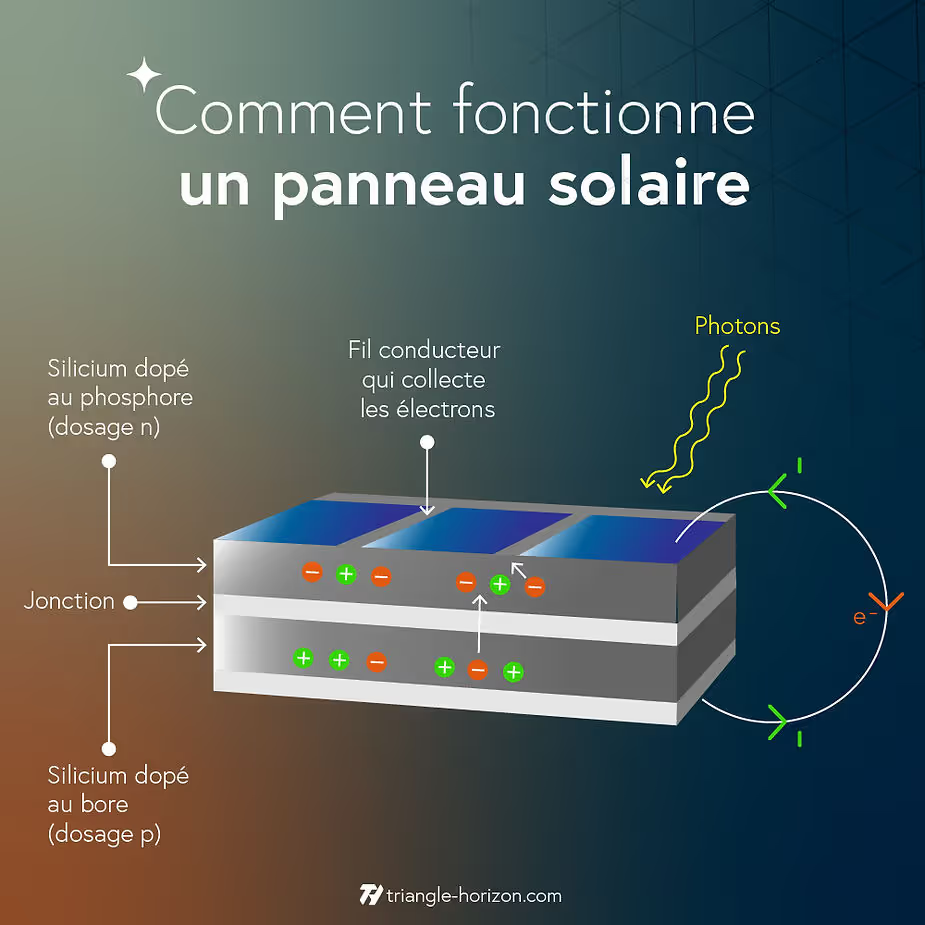
When sunlight strikes photovoltaic cells, photons (particles of light) transfer their energy to the electrons in the silicon. This energy allows the electrons to break free from their atoms.
Step 2: Generating an Electric Current
Photovoltaic cells consist of two layers of silicon that have been “doped”—that is, their electrical conductivity has been altered—to create two distinct layers:
- An electron-rich N-type (negative) layer
- A P-type (positive) layer that is electron-deficient
This difference creates an electric field at the junction of the two layers. The released electrons migrate toward the negative layer, thereby creating a direct current.
Step 3: Electricity Generation and Transmission
Metal contacts on each side of the cells collect the electricity generated. The cells are connected in series within the panel to increase the voltage, and the panels are then connected to one another to form a complete photovoltaic system.
From Direct Current to Alternating Current
The electricity generated by solar panels is direct current, which is incompatible with the French power grid, which operates on alternating current. An inverter therefore converts this direct current into alternating current that can be used by our electrical appliances or fed back into the grid.
Factors Affecting Yield
Several factors affect a solar panel’s electricity production. First, there is solar radiation. The intensity of solar radiation varies depending on the season, location, time of day, and weather conditions. A solar panel produces more electricity on sunny days than on cloudy days.
Excessively high temperatures can also reduce a solar panel's electricity output. The orientation of the solar panel is also important: it must face due south at an angle of 30 to 35 degrees in order to receive optimal sunlight from morning to evening.
Types of Solar Panels
Monocrystalline panels
Made from a single silicon crystal, they offer the highest efficiency but are more expensive. They are uniformly black in color.
Polycrystalline panels
Composed of several silicon crystals, they offer slightly lower efficiency but are more affordable. They have a bluish appearance with iridescent highlights.
Thin-film panels
Less common, they use materials such as amorphous silicon. Although less efficient, they perform better in low-light conditions. These solar panels also have the advantage of being lighter and more flexible.
Triangle Horizon: Expertise to Support Your Solar Projects
With 10 years of experience in the photovoltaic industry and 1.4 GW of installed capacity, Triangle Horizon has expertise in every stage of the solar installation process, whether for shade structures, solar fields, or agricultural buildings. From design in our engineering department to installation by our specialized teams, including manufacturing in our 80,000 m² of workshops spread across three sites, we guarantee sustainable and high-performance solutions.